
Aurian
Art by Cate Standish
So Below
As the other half of the Suncatchers mythos, Aurian has his own balance to obtain. Serving as the “heart” of the duo, he must overcome the trauma of abandonment, both from birth and the planet he serves, Yjoulai. Compounded with his religious upbringing, the most difficult piece is finding himself in the list of things that define him.
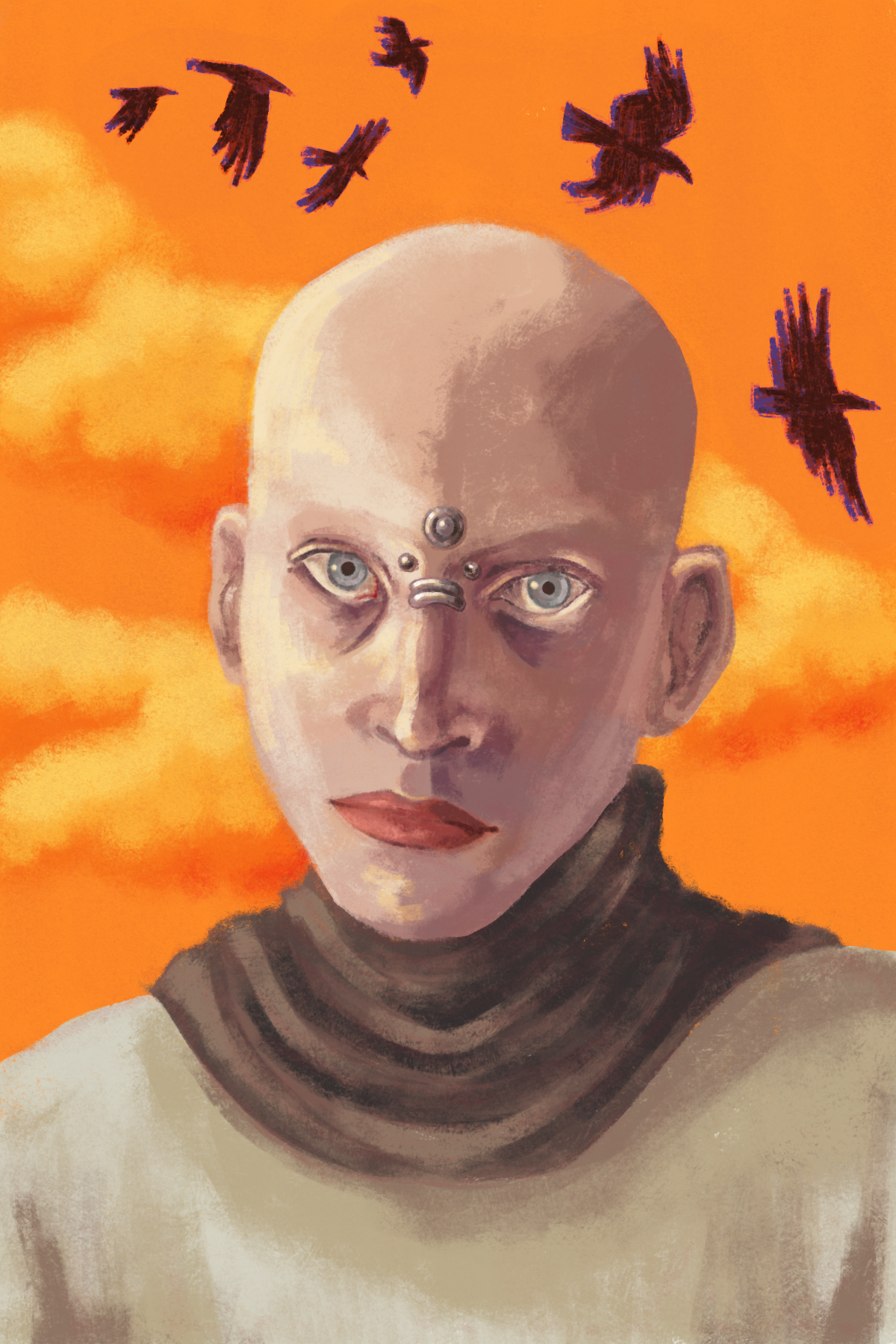
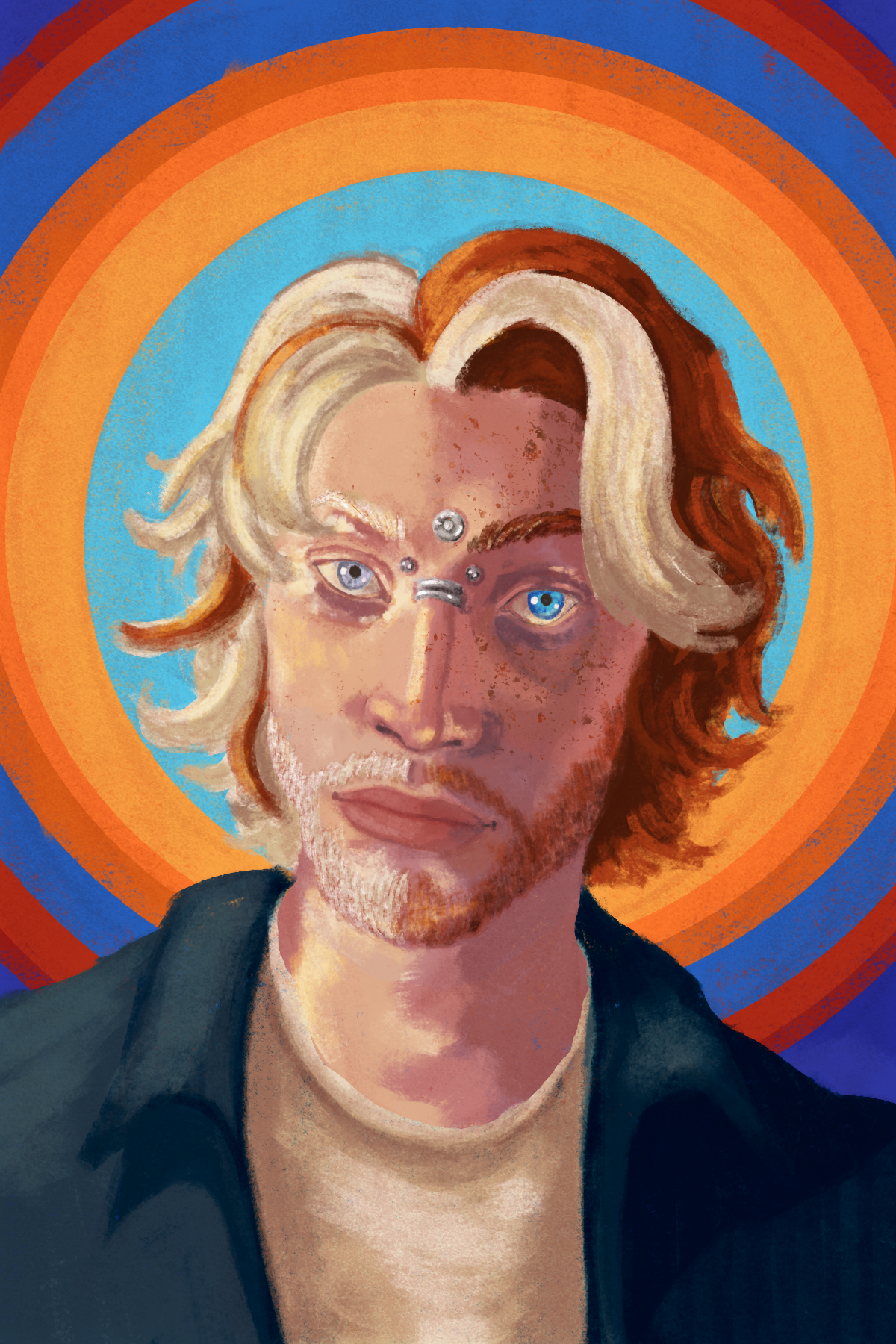
Aurian begins with intuitive powers, able to use to his aura to feel the emotions of others and even sense what they may be thinking at times. Seen as a child prodigy, he was able to master certain elements of the priesthood that many, many couldn’t dream of. This included weather prediction, floating while meditating, and of course his empathic abilities. As a priest, Aurian lost his hair and melanin like the others that bathed in the caves under River Redstone. But after ten years away, he slowly gained his color back. But curiously, it only appeared on one half of his body - an unexplainable phenomenon that even Berkeley couldn’t figure out.
As the mystical “divine feminine” expression, Aurian’s primary challenge is to look up at the mind, finding ways to take action as that’s what his powers require. But the emotional battle can oftentimes be more difficult than the physical one, and Aurian might not be up to the task.
Inspirations for Aurian
Aurian was an incredibly fun character to write, particularly because he served as an exploration into the hidden aspects of healing. On the surface, his archetype aligns more with the “divine feminine”: his outward expression is emotional, but there can be a shadowy side to that if not balanced. Combined with a “golden retriever” personality, he’s no exception to the quirky layers within the characters.
A very common response to emotional healing is inherently shadow feminine: dissociation, self-blame, victimhood, and even just emotionally lashing out. All of these in some way are a form of the mind/body protecting itself. Be it the things you may have told yourself, the subconscious actions you take, or sometimes even how you are more reliant on others than yourself. The chaos of processing trauma is, for some like me, much more difficult than processing the facts or reasons how or why something happened.
And once again, “feminine” in this context doesn’t refer to gender at all. It is the metaphysical expression of it (and both masculine and feminine are in everyone, just along different spectrums). That being said, confronting my wounded feminine was a thousand times more difficult because it was the emotional part. It was the impulsive, chaotic, faster moving part of myself that I didn’t know how to tame. But, simultaneously, it was also the part I ignored the longest. It ended up lodged so deeply into my nervous system that exposing it felt like actually dying. My mind had spent years protecting it, telling me stories or skewing memories so I could, in some way, feel justified or protected (whichever was needed most).
Ironically, it never needed to be tamed - it needed to be heard. It needed to know that feeling was okay, and doing so wouldn’t leave me in the scary place again. I had to teach my feelings that they were safe. And once that processes started, some really incredible, unexplainable things began happening. My gut feelings became intuition. That “empathy” I felt ashamed of or used to sense someone’s emotional state (another form of self-preservation, of course), turned into a tool that I could learn from and set better boundaries with.
But settling the mind and the heart didn’t happen simultaneously. They would ebb and flow, sometimes one taking control over the other. And during that process, I felt like I was going insane - like there were two different people inside of me, both grabbing at the steering wheel while I watched the car get dangerously close to a cliff’s edge. And even moreso, there was a very scary point where “honoring” my feminine bordered madness - something some may call “spiritual psychosis”. It was brief, but it gave me a lot of perspective. And that’s another aspect of Aurian: feeling chosen. IFYKYK.
A funny thing about Aurian is that he doesn’t really respond to being seen as “the chosen one”. And he’s right to, because he isn’t. Not by himself, at least. But the added layer of abandonment is what makes his core wound around being chosen so rich. He desperately seeks understanding of himself, but for ten years doesn’t really do much to find out. Instead, he helps Sunny and dissociates, looking for anything external to validate he is worthy to exist. When all he had to do was look at his own face, seeing the line of distinction between his two halves. But he wants Sunny to choose him - something he doesn’t always get.
And that’s the hairpin trigger I see a lot in spiritual communities. It’s the complete disregard for the physical, the mind, and third dimensional reality. Which, once again, only serves “polarity”. It’s blending the two together and forming one, fully realized version of yourself that uses thought and feeling to make whole decisions. At one point in my journey, I couldn’t make a single decision without whipping out my tarot cards or my dowsing rods. The universe, god, my guides, my dead great-great-great aunt, SOMEONE (ANYONE) had to know the right answer because there were just so many possibilities and I couldn’t predict the right answer. Hello! S.O.S. I’m losing it, here!
But that was the abandonment. That was the trauma. That was a false version of “intuition”, even though I had just gotten glimpses of the real thing. And Aurian was written with a little bit of both, because it happens to people. But the only way out is finding the non-judgement of self: the zero-point neutrality so everything can be seen clearly for exactly what it is.
Aurian’s dilemma is opposite Sunny - he has to rise up to the mind and take action, because that’s what his power requires. He is a boundary, a protective field, that contains the “light” and holds it into the physical. Because what else holds the sun like a water’s surface?